
CienciaPR Hopes To Raise Science Interests in Puerto Rico

Now is the perfect time to get involved in the sciences or STEM for short especially in Puerto Rico where unemployment is high and many of the island’s youths are leaving the for the Unites States for better opportunities.
The sciences and technology could lead to more innovation, more entrepreneurship and more encouragement to stay and make Puerto Rico a hub for scientific research, pharmaceutical manufacturing and start-ups.
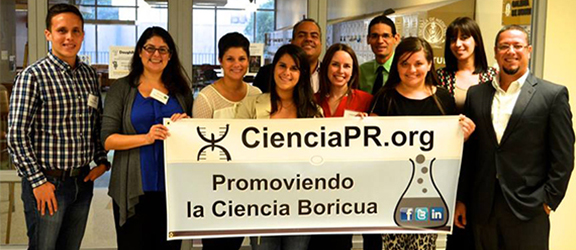
I had a great opportunity to interview one of these individuals who continues to strive to bring science education to the island. Her name is Dr. Monica Feliu-Mojer and she is the Vice-Director and Program Manager of CienciaPR, a Puerto Rican based organization that helps raise interests in the sciences through online media technology.

Tell me a little bit about your organization?
Ciencia Puerto Rico is a non-profit organization that uses social networking to connect a geographically dispersed scientific community with ties to Puerto Rico and leverages their knowledge wealth and professional capital to promote social impact initiatives in science education and communication in Puerto Rico. We are the largest network of Puerto Rican scientists in the world and one of the largest networks of Hispanic scientists.
What made you passionate about this organization?
When I left 10 years ago to pursue a career in science in the U.S. one of my motivations was being able to come back and contribute to the advancement of science in Puerto Rico. Even though I wasn’t physically in Puerto Rico, I wanted to stay connected to the scientific community there, contribute and continue learning from them. CienciaPR gave me and still gives me that opportunity. Volunteering and now working for CienciaPR has allowed me to leverage my scientific training, my networks, my knowledge to advance science in Puerto Rico, to bring science closer to Puerto Ricans. Being part of this organization is one of the most transformative experiences I’ve had. It helped me discover my vocation and combine my passion for science and for contributing to the archipelago.
With a background in the sciences how are you helping to promote the various fields to young students in Puerto Rico?
In a nutshell I use my science training to bring science closer to people, to make it relatable, accessible and relevant to different audiences. For example I write popular science articles for media outlets like El Nuevo Día or Diálogo Digital. I also blog for networks like CienciaPR Blogs or the Scientific American Blogs Network.
A big focus of CienciaPR’s work is on supporting young scientists and encouraging the next generation of scientists. For example, we have projects with K-12 schools in Puerto Rico and have developed resources that teachers can use to help make science relevant to the lives of Puerto Rican students. This past year we launched a series of videos (www.cienciapr.org/videos) on the topic of space exploration that feature Puerto Rican scientists, their work and research happening in Puerto Rico. These videos are accompanied by guidelines that teachers can use to incorporate the videos into their classes.
CienciaPR also puts big emphasis on highlighting scientific role models to inspire young people. We do this through the articles we publish in collaboration with about a dozen media outlets in Puerto Rico, the U.S. and Spain; through podcasts available on iTunes and our website; and through blogs and monthly profiles, among other ways.
Obviously using online content strategies is essential in spreading the message. What platforms and technologies are you using to promote and educate online? What are your strategies to reaching your target audience?
Online and social networking strategies are key to the work we do. The CienciaPR community (almost 7,000 members and counting) is all over the world, in 48 jurisdictions of the U.S. and 50 countries. It is because of our customized social networking platform (built on Drupal 7) that we are able to reach them and make meaningful connections. If it wasn’t for our online platform many of these people would not be able to connect or know about each others work.
We also rely heavily on social media, particularly Facebook and Twitter.
I would say the most important strategy we use is cultural relevance. Central to our communication and education programs is to make science relevant to the context and culture of our audience. We want to make science matter to people.
What are your long term goals for this organization?
Our long term goals are to continue strengthening the science ecosystem in Puerto Rico through the promotion of research and education. We aim to grow our K-12 educational programs. We also want to continue increasing science literacy in Puerto Rico. We believe that science education empowers everyone to fully participate in society.
Over the last few years we have become a leading voice in the promotion of diversity and inclusion in science in the U.S. We want to continue to be a model to reach underserved communities and support diversity in science.
Are you looking to expand outside the island?
Although a lot of our work focuses on the Puerto Rican archipelago, due to the online nature of our platform and the dispersed nature of our community and the CienciaPR team we are already having an impact outside Puerto Rico.
Our website is fully bilingual, but a lot of the science content is in Spanish, filling a huge need not just for Puerto Rican but for Spanish-speaking audiences. Besides Puerto Rico a large number of visitors to our website come from the U.S.
We see our work as a model for other underrepresented minority and geographically dispersed scientific groups or diasporas. Through our platform we have successfully engaged scientists to become involved with their communities and in science education and communication. We have been approached by groups from other countries to replicate our model and we are very interested in helping them do this.
For more information, check out the links below.
http://journals.plos.org/
http://www.cienciapr.org/es/
Related articles
- How Undergraduate Journals Foster Scientific Communication (blogs.plos.org)
- Part 1… STEM Resource Series… Over 70 Stemtastic Sites (21centuryedtech.wordpress.com)
Read Next